

The Secret Life of This Life Now is a section of Beachcomber Mike. To unsubscribe from this section, see instructions at the bottom of this post.
I recently bought from my publisher the last 100 or so copies of This Life Now (A Midsummer Night’s Press, 2014), my Lammy-finalist first book of poems. If I can persuade 100 or so people to make those copies disappear, this book will be blissfully out of print. These essays are a ploy to pique your curiosity so you will snag one for yourself.
This is post #16 in the series. Still in the second section of the book, “Portrait of the Artist as a Young Sodomite.” Poems of sweet, innocent childhood. The fifth poem in this section, and the 16th in the book overall, is “Mod Squad.” As in the TV series about three hippie cops—Pete, Linc, and Julie— that ran on ABC from 1968 to 1973. Here is the first one-third or so of this poem.
[Note: This is a prose poem, but Substack does not support justified text.]
          I didn’t leave home, I was kicked out, Pete says to Linc as
          they drive conversing in close-ups through the night.

          I had the hots for Pete, and for Wally Cleaver, and for
          Chip, the middle of Fred MacMurray’s three sons, but
          never for any of the Brady boys, although possibly for
          the original youngest son (Chris) on The Partridge Family,
          the dark haired one with the big brown eyes (Jeremy
          Gelbwaks), not that blond dork (Brian Forster) who
          replaced him in season two.

          Yes, Jeremy Gelbwaks was prepubescent, but so was I, so
          there was nothing icky about it.
The poem goes on from crushes on TV actors to crushes on boys in middle school and high school.
In recent posts, we’ve gotten away from the personal history portion of the program. In Secret Life #13, I gave you an overview of my first decade of life (1961–70) via a series of Sapphic stanzas. In 1972 my dad died of colon cancer. Colon cancer does not develop overnight, but he had apparently ignored symptoms and did not get regular checkups. And in any case, we did not do routine colonoscopies or occult blood tests starting at age 40 when there is a family history, the way we do now. So when my mom finally insisted that my dad go to a gastroenterologist, if was far too late. The doctor ordered him right into the hospital, and it was all of twelve days from biopsy to coffin.
Martin Broder—son of Jacob and Alice, brother of Frances and Eugene, husband of Lee Brecher, father of Henry, Freddie, Victor, and Michael—died on July 7, 1972, at the age of 52. I was 11 years old. Victor was 15. My mom was 50. A widow at 50. With two minor children living at home, and a severely disabled 17 year old son, my brother Freddie, in a state institution. What followed were dark years. Sad years. Financially difficult years.
My father had been self-employed as a commercial artist (what today we would call a graphic designer). As I wrote—and you may have read—in my poem “Years” for 1964,
          Dad, forty-four, mends from a heart attack and
          makes the switch from sales to commercial art, the
          doctors having said he could neither smoke nor
          carry his sample

          cases any longer
So he went from selling risqué novelties to concessionaires—pens with pictures of girls on the barrel whose dresses came off when you turned the pen upside down, that sort of thing—to drawing straight lines between newspaper ads. Literally. That’s the kind of drafting work he started out with. That was a skill that was in demand at publishing houses and in other settings before computers.
My dad was an amazing draftsman. It is impossible for me to know why he did not pursue a career in the visual arts from the beginning. But you may remember that my dad’s parents were both deaf mutes, had gotten legally separated when my dad and his younger brother and sister were minors, and the three siblings grew up in a series of foster homes, separated from each other until my father turned 16, got emancipated, and reunited his family—not only his siblings, but his parents! Maybe that was all the heroism he could handle for a while. Maybe he needed to lay low.
I lack a lot of the details because I was so young. But I know that after the heart attack, he managed to snag a gig as a freelance draftsman for McGraw Hill, the publishing company. At the time, they were in their legendary Art-deco skyscraper at 330 West 42nd Street.
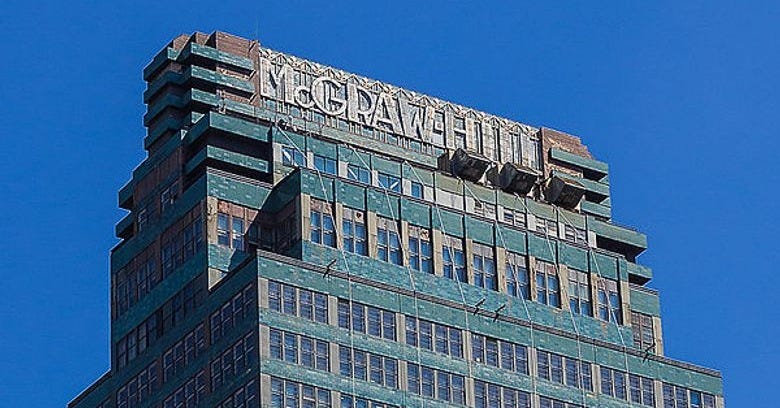
McGraw Hill gave him access to a drafting table and allowed him to do work for his own clients as long as he was available when they needed him to draw a straight line. I don’t know where these clients came from. Presumably my dad was hooked up in ways I have no knowledge of. Probably should not be surprised. The guy’s 45 years old. Grew up in New York. Served in the army in the Pacific Theater for the four years of WWII. Was active in his local American Legion post. Had been in business with an old army buddy of his running a dry goods store called Coast to Coast at 889 Broadway, where Fishs Eddy now resides. Then the novelties racket. He had to have picked up some useful contacts along the way.
Anywho. I think it was when my brother Henry came back from his stint in the naval reserves that the two of them leased an office-slash-studio at 611 Broadway, the Cable Building, on the northwest corner of Houston Street, where Angelika Film Center is today. It was Henry who actually had the college education in graphic art. It was Henry who taught my dad how to turn his stunning drafting skills into a living.
Drafting tables, illustration board, Rapidograph pens, X-Acto knives, Best-Test rubber cement, tracing paper, masking tape—all the tools of the trade back in the 1960s: It was Henry who had learned about that stuff at New York City Community College on Jay Street in Downtown Brooklyn. That’s were Henry met the woman who would become his wife, also an art and design student at NYCCC. Henry and Kathy got engaged in 1965. Then Henry went into the naval reserves for two years—the patriotic thing to do, and a safer bet than waiting for your number to come up in the draft lottery.
Henry served on the USS Entemedor, which deployed from its home port in New London, Connecticut, to the Mediterranean to serve with the 6th Fleet. Henry was assigned to the galley and remained a cook at heart his whole life. His son, my oldest nephew, followed in his dad’s culinary footsteps and became a professional chef after graduating from Johnson & Wales University in Providence, Rhode Island. (My niece, by the way, got the visual art gene from her mom and her dad and the grandfather she never knew, graduating from Rhode Island School of Design and pursuing a successful career as a working artist and art teacher.)
Clearly I’m proud of my family and have veered off the autobiographical path a bit. What I got diverted from was the dark and uncertain path I was on once my father died. I’ll get back to that. But I will close for now with a poem that was published in the journal Softblow in 2006 as part of a sequence called “Syntax of Loss.”
          I was eleven. He was fifty-two.
          I want to say you were fifty-two.
          But he is not my second person,
          like the lovers at whom I can be angry,
          or regret something we said or did not say to each other,
          but still say you.
          He is he, that man over there,
          way off in years, not me, not my.
          Today makes 30 years. Last night
          I lit the candle that will burn for 24 hours.
          It will burn for him.
When it was first published, some people seem to have thought this poem had something to do with sexual abuse—maybe because I compare my intimacy with my father to my intimacy with a boyfriend. But it’s not about that. It’s about the sad fact that I was not able to develop the level of intimacy, of connection as father and son, that I wish I had been able to develop before he was taken from me when he and I were both so young. The candle—begging the pardon of those readers to whom this is perfectly obvious—is a yahrzeit candle, a Jewish memorial candle that you burn from sunset to sunset on the anniversary of the death of a loved one. The word yahrzeit is Yiddish and literally means “time of year.” I wrote this poem on or about my dad’s 30th yahrzeit in 2002.
Wow, this is the longest Secret Life post so far. Thank you for making it this far. Back next time with still more portraiture of the artist as a young sodomite. À la prochaine.
Get your copy of This Life Now, well...NOW! The bargain-basement fireside-sale price of $10.00 includes SHIPPING in the US.
Scheduling Note: I am going to publish posts in this series on Mondays and Thursdays at about noon eastern time. Second Coming posts seven days a week at 6:30 a.m. eastern time.
The Secret Life of This Life Now is a section of Beachcomber Mike. To unsubscribe from a section:
1. Navigate to your account Settings page via www.substack.com/settings and click on the publication you want to make changes to.
2. Slide the toggle next to each section you'd like to stop receiving emails or app notifications from. A gray toggle indicates that notifications will be off for that section.
I was also 11 when my father died, he was 49. I love that ritual, to burn a yahrzeit candle each year.